Glimpses from India and around the world that will make you smile and cry.
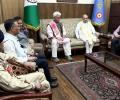
Union Home Minister Amit Shah arrived in Srinagar to review the security situation in Kashmir following a deadly terror attack in Pahalgam that killed 26 people, including tourists. Shah chaired a high-level meeting of security officials, including those from the Army, CRPF, and police. The attack, claimed by The Resistance Front (TRF), a shadow group of the banned Pakistan-based Lashkar-e-Taiba (LeT) terror group, is the deadliest in the valley since the 2019 Pulwama strike.

Pakistani wives of former militants rehabilitated in Kashmir have pleaded with the government to allow them to stay, stating they would rather die than return to their native country. The women, who came to Kashmir under a 2010 rehabilitation policy for former militants, have been asked to leave by the police. They say they have built lives in Kashmir and fear for the future of their children if they are forced to return.
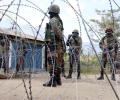
The AFSPA, often criticised as a draconian law, gives armed forces operating in disturbed areas sweeping powers to search, arrest and open fire if they deem it necessary.

Investigations said the accused was engaged in sharing classified details, including troop deployments and strategic locations, posing a threat to national security.

President Droupadi Murmu's address to the nation on the eve of the 79th Independence Day.

Vishal Yadav, an Upper Division Clerk (UDC) in the Directorate of Dockyard at the Navy building, allegedly also shared details on Operation Sindoor -- strikes carried out by the Indian Armed Forces in Pakistan and Pakistan-occupied Kashmir in response to the Pahalgam terror attack.
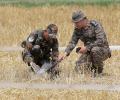
Metal debris was found scattered in three villages of Amritsar district, with some locals claiming them to be parts of missiles. Police are investigating the objects, while the Indian government claims to have foiled Pakistan military's attempts to attack 15 places in northern and western India using missiles and drones. Tensions between India and Pakistan have escalated after India launched missile strikes on terror targets in Pakistan and Pakistan-occupied Kashmir (PoK) in response to the April 22 killing of 26 people by terrorists in Kashmir's Pahalgam.

Union Home Minister Amit Shah has stated that Naxalism, currently confined to just four districts in India, will be completely eradicated by March 31, 2026. He emphasized the crucial role of the Central Reserve Police Force (CRPF), particularly its CoBRA battalion, in achieving this goal. Shah lauded the CRPF's contributions to national security, highlighting their efforts in combating terrorism in Kashmir, maintaining peace in the Northeast, and significantly reducing Naxal violence. He also paid tribute to the CRPF's sacrifices, acknowledging the loss of 2,264 personnel in the line of duty.

New Delhi looks to be testing Omar's endurance with unconcealed glee, never feeling shy to bite whenever a moment comes its way. After all, ruling the country's only Muslim-majority UT/state has been the BJP's burning desire, points out Mohammad Sayeed Malik, the distinguished commentator on Kashmir affairs.
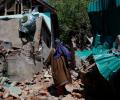
Authorities in Kashmir have launched a massive crackdown on terrorists and their sympathisers in the aftermath of the Pahalgam terror attack, razing homes of the ultras, raiding their safe havens and detaining hundreds of overground workers for questioning, officials said on Saturday.

Sri Lankan police searched a flight arriving in Colombo from Chennai after receiving a tip that a suspect linked to the Pahalgam terror attack could be on board. The search was conducted in coordination with local authorities following an alert from the Chennai Area Control Centre. The aircraft was thoroughly inspected and cleared for further operations.

'The Indian Army won't induct anyone who has killed Indian soldiers.' 'That's why the army respects these reformed men so much -- they're on the frontline now, protecting India.'

The empty cartridges found at Pahalgam and those after test firing by the recovered guns were matched by the forensic lab, Shah said. The ballistic report is with him, he added.
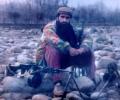
'A man with a gun commanded respect. I thought if I also got a gun, I could save my family. With this thought, I went to Pakistan and got training there'

The National Investigation Agency (NIA) has started interviewing eyewitnesses, including tourists, in connection with the deadly terrorist attack in Pahalgam, south Kashmir. The attack, carried out by terrorists from the Pakistan-based Lashkar-e-Taiba (LeT), claimed the lives of 26 people on April 22. Initial investigations suggest that five to seven terrorists were involved, aided by local militants trained in Pakistan. Security forces are conducting massive operations to hunt down the terrorists in the dense jungles of the Pir Panjal range.

Heavy security has been deployed at vital installations in Delhi, including government buildings and areas with high footfalls, following Pakistan's drone attacks on Indian military sites. Police have strengthened vigil in areas with high footfalls and have canceled leaves for all Delhi Police personnel. The developments come after India swiftly thwarted Pakistan's attempts to strike military sites with drones and missiles.
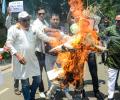
The Madhya Pradesh high court on Thursday expressed dissatisfaction with the first information report (FIR) registered by police on its orders against minister Vijay Shah regarding his objectionable remarks about Colonel Sofiya Qureshi, and said it must be comprehensive.
11, 13, 15 are not some random odd numbers but the number of days that Prime Minister Narendra Modi took to act against Pakistani terror strikes on Indian soil.

A case of attempt to murder and dacoity has been registered against three army lieutenant colonels and 13 others for their alleged involvement in a violent attack on the Kupwara police station, according to the FIR.
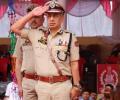
Dilbagh Singh, the Director General of Prisons, was directed to hold the charge additionally
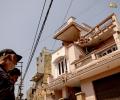
The casualties were reported hours before India and Pakistan agreed to end hostilities, which soared after the Indian Armed Forces hit terror launchpads in Pakistan and Pakistan-occupied Kashmir earlier this week in response to the Pahalgam attack.

Days after the Pahalgam terror attack, Jammu and Kashmir authorities have deported 59 Pakistani nationals, including the mother of Shaurya Chakra awardee Constable Mudasir Ahmad Sheikh. The Pakistani nationals were living in the valley for decades and were transported to Punjab for repatriation. However, the mother of the deceased soldier was later allowed to stay back. The deportation comes after the Indian government announced a slew of measures against Pakistan in the wake of the Pahalgam attack, including the suspension of the Indus Waters Treaty and the downgrading of diplomatic relations.

Bharti is probably the only BJP leader who has openly condemned Shah's remarks and sought action against him after the Madhya Pradesh high court ordered police to register an FIR against the minister earlier in the day.

Jyoti was among 12 people who have been arrested from Punjab, Haryana and Uttar Pradesh over the past two weeks on charges of espionage, with investigators pointing at an alleged Pakistan-linked spy network operating in north India.
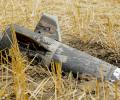
Debris resembling parts of a missile was found in a field in Hoshiarpur, Punjab, while metal parts of unidentified objects were discovered at two locations in Bathinda, sparking panic among locals. The incidents come after India successfully thwarted Pakistan's attempts to target military installations with drones and missiles across the country.
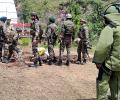
The officials said dozens of unexploded explosives were destroyed by the experts along the Line of Control in Rajouri and Poonch districts and along the International Border in Jammu and Samba which witnessed intense cross-border shelling and drone attacks from May 7 to May 10.

Ashoka Univeristy associate professor Ali Khan Mahmudabad has been arrested for his social media post on Operation Sindoor, police said in Sonipat on Sunday.
'It was inspired by the Hamas attack and was like their attack -- well planned and well executed.'

Mahmudabad, head of the political science department at the private university, was arrested on Sunday after two FIRs were lodged on stringent charges, including endangering sovereignty and integrity, for his social media posts related to Operation Sindoor, police and his lawyer said.

A student from Jammu and Kashmir studying at a pharmacy college in Nagpur was thrashed by a group of local residents, prompting police to investigate the incident. The student, who ruled out a hate motive, said he was attacked by "anti-social elements" after being questioned about his origin. The J&K Students Association has called for action against the perpetrators.

India on Thursday night swiftly foiled Pakistan's attempts to hit various key Indian installations including military stations at Jammu, Pathankot and Udhampur with drones and missiles, the defence ministry said.

A villager was killed and three others were injured in shelling by Pakistan in forward areas of Jammu and Kashmir's Poonch and Rajouri districts early Friday morning, prompting Army troops to retaliate. The shelling also caused significant damage to property, with many houses and hundreds of vehicles affected. The firing and shelling were directed at areas in Rajouri, Poonch, and Jammu districts, apart from Kashmir's Kupwara and Baramulla districts, overnight.

The truck loaded with husk was intercepted near Sidhra's Tawi bridge checking point along Jammu-Srinagar national highway on Wednesday morning

People along the Line of Control and International Border in the Jammu region continue to live under the shadow of death, with unexploded mortar shells fired by Pakistani troops still embedded in farmlands and residential areas even though hostilities have stopped for nearly a week. IMAGE: Kindly note that this image has been posted for representational purposes only. Photograph: / Rediff.com Despite the May 10 understanding between India and Pakistan, locals describe the border areas as a 'death trap'. Sixty-two-year-old Balvinder Singh, who returned to his home in Pargwal sector on May 14, recounted a narrow escape. "Two shells exploded in our compound, damaging our house. Three more landed on our farmland. We were terrified and told our family to stay away from the fields until the Army could help," Singh told PTI. Army engineers later came to the village and safely defused the unexploded shells, bringing a temporary sense of relief. "Fear is writ large on the faces of people to these death traps in border hamlets", he said. Scenes of destruction are evident rooftops torn apart, broken houses, windows punctured by shrapnel, and carcasses of cattle lying in pools of blood. The acrid smell of gunpowder still lingers in the air. Sardar Gurmeet Singh faced a similar ordeal. His family could not re-enter their home as a live mortar shell had sunk into the compound in a village close to the International Border. "The army's bomb disposal squad removed it after four days, allowing us to finally enter, back home," he said. Indian Army engineers have launched a sweeping clearance operation across border districts, defusing over 80 unexploded shells in the past five days -- including 6 in Pargwal, 19 in Rajouri, 42 in Poonch, and 12 along the IB. "These shells, mostly 120 mm calibre, have a range of 15 to 30 km and pose a serious threat to both civilian and military targets," an Army officer said. "Many of them were fired by Pakistan during recent hostilities." On May 7, the Indian Army launched Operation Sindoor, conducting precision strikes on nine terror hubs in Pakistan and Pakistan-occupied Jammu and Kashmir (PoJK) in response to the April 22 terror attack in Pahalgam that killed 26 people, most of them tourists. The subsequent retaliation by Pakistan pushed the region to the brink of war. From 7 to 10 of May, 27 civilians were killed and over 70 injured in Pakistani shelling in the Jammu region. Farid Din Gujjar, a resident near the border, expressed fear about returning to his fields. "Several shells created deep craters in our paddy land. We cannot resume work until all unexploded ordnance is cleared. It's a death trap," he said. Army units, in coordination with Jammu and Kashmir Police, have evacuated high-risk zones and issued stern warnings to residents not to touch any suspicious objects or unexploded shells. In one major operation, 42 live shells were safely destroyed in the Poonch villages of Jhullas, Salotri, Dharati and Salani. "All safety protocols were followed. The shells posed a serious danger to local lives," an Army spokesperson said, calling the effort a 'continued commitment to protect civilians and restore normalcy'. Poonch saw the vast majority of deaths due to shelling. Security officials said that Pakistan used a mix of mortar shells, armed drones, and missiles during the shelling spree, specifically targeting civilian habitations and border towns in Jammu, Samba, Kathua, Rajouri, and Poonch. As clearance operations continue, the border residents are slowly returning to their homes, but with caution, fear, and lingering uncertainty about shelling that may yet happen in the future.

It is considered one of the most crucial appointments within the Indian Army, according to an official statement from the Ministry of Defence.

'Trump has personally weighed in to overcome doubts and reservations about Pakistan among his top advisors.'

Suspected drones were observed along the International Border in Samba district of Jammu region on Monday, while armed forces downed a 'surveillance drone' in Punjab's Jalandhar district.

The Udhampur-based northern command is committed to eliminate the scourge of terrorism in Jammu and Kashmir, the Army said on Tuesday, as it paid tribute to four soldiers who died in a gunfight with heavily armed terrorists in Doda district.
When the internal security situation spirals out of the control of the provincial law and order machinery, the CAPFs can be called in, providing a security buffer before the Army is deployed.
